30

Oct

What Most Companies Get Wrong About Warehouse Mezzanine Floors

When warehouse owners are looking to improve the layout of their unit or increase storage capacity there are plenty of efficient and space-saving options they can incorporate. Anything from different racking systems that maximise capacity to wall partitioning systems that can divide the warehouse floor into zones. But, when your floor space is at maximum capacity you either have the expensive option of building alterations, relocation or, what are becoming the go-to solution – warehouse mezzanine floors.

Yet, while mezzanine floors can easily create additional floor space, finding a compliant solution that works for your business is harder to achieve. In our blog we look at the dos and don’ts of installing warehouse mezzanine floors.
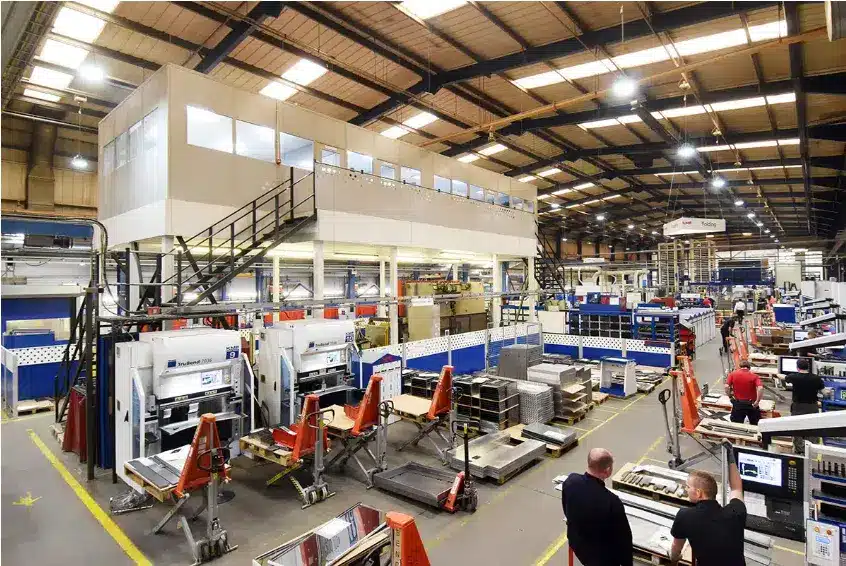
Warehouse mezzanine floors in factory

What is the purpose of warehouse mezzanine floors?

When you step into most warehouses, you usually find a significant volume of unused vertical space sitting directly above your head. Mezzanine flooring simply utilises an area that would otherwise go unused and turn it into a valuable asset, maximising storage space.

A mezzanine will provide numerous solutions for your warehouse including:

  • Quickly creating more floor space

    A mezzanine sits above the traditional footprint of your warehouse and creates an additional floor. However, the big bonus is the fact there is limited building work involved in their installation, they are typically quick to install with minimal disruption to your everyday warehouse operations.

  • Reduce costs and increase profitability

    Most business owners would prefer to avoid the high cost and disruption of extending their current unit or relocating to a bigger warehouse. However, when space is limited this can impact on business growth. A factory mezzanine floor is a cost-effective storage solution that allows your business to expand. Plus, as a modular solution, you can easily adapt or extend your mezzanine in the future as your business continues to grow.

  • Enhance your operations

    A warehouse relies on numerous teams to ensure it runs at optimum productivity. The roles of inventory control, warehouse operations, order fulfilment, sales teams, administrators and project managers all need to interlink to ensure a seamless deliver on customer orders. Warehouse mezzanine floors can bring your teams together into one space by creating unique work zones that suit your requirements. You can even add soundproofing to your mezzanine to create an office space that still feels quiet even in the middle of a busy industrial environment.
What is the structure of a mezzanine floor?

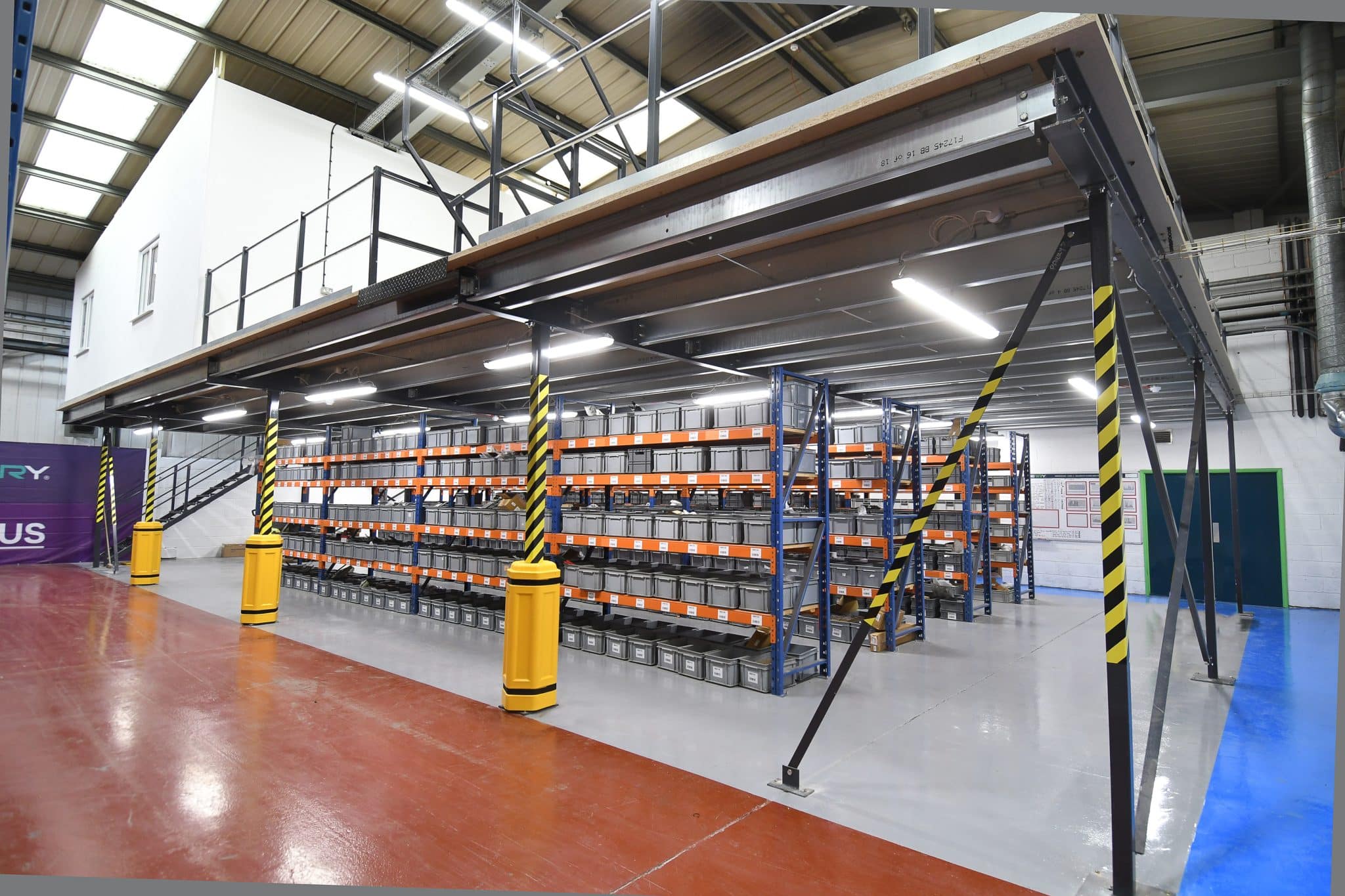
Most mezzanines will bear common design features, each incorporated for safety, storage, or access requirements. Here at Teepee, our floors can be designed with all of the following:

Key Design Features of Mezzanine Flooring:

  • Columns – the mezzanine platform is raised above the warehouse floor with columns and metal support beams made from steel or aluminium.
  • Access – custom-designed staircases are the most commonly used methods to access the mezzanine including straight, U-shaped, or L-shaped options. However, you can also have the option to install goods lifts and hoists for safe vertical movement of heavy items.
  • Floor space – you can choose from either a fully enclosed floor with walls and partitions or partially enclosed to leave an ‘open’ balcony-style appearance. You can also opt for a partial extension across the floor to allow visibility of ceiling of the next floor level.
  • Flooring – you can choose options such as timber decking and steel chequer plate
  • Safety features – this includes details such as handrails and safety barriers.
  • Lighting and electrics – including emergency lights and cable trays. We can also install alongside HVAC systems.
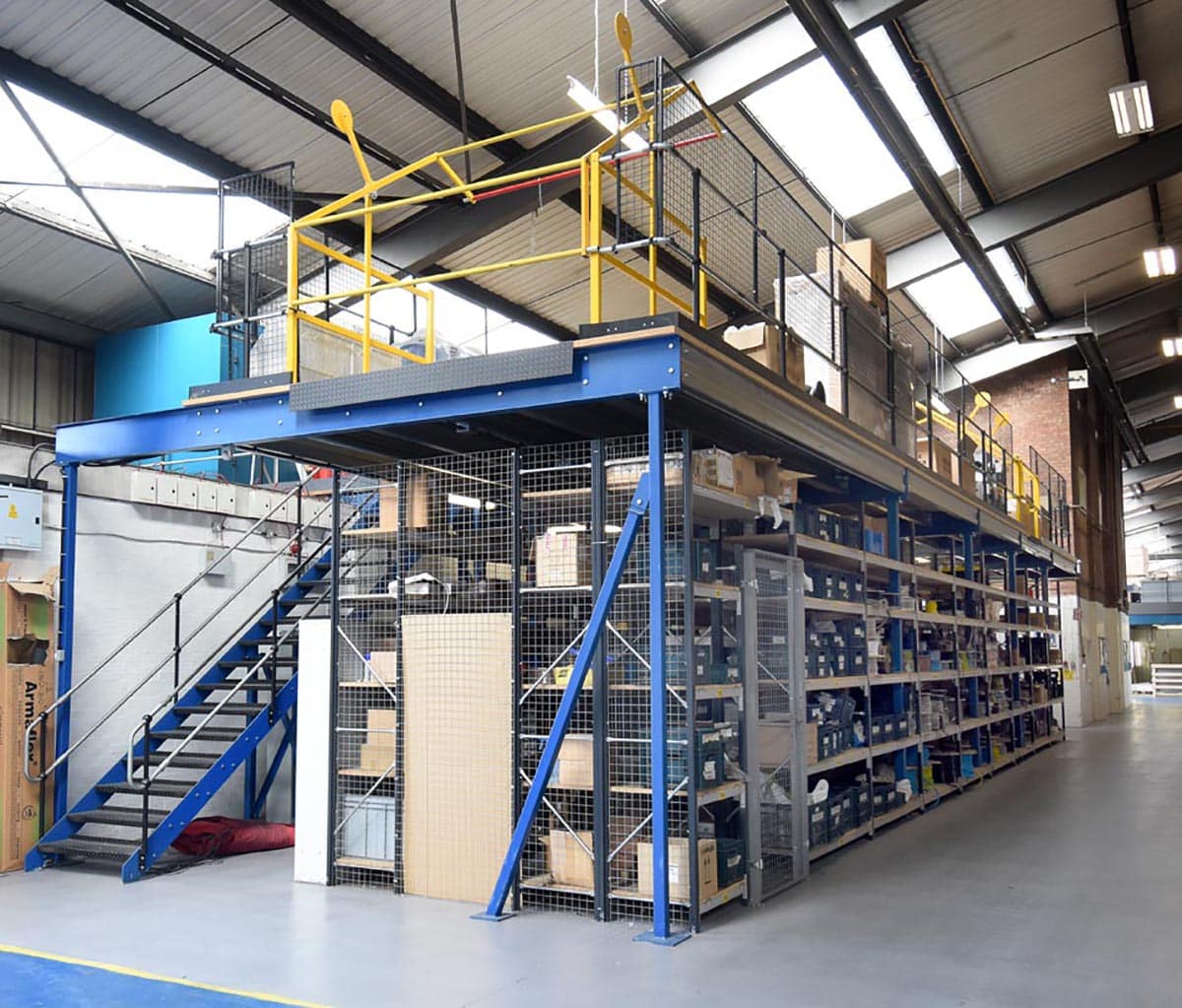
What are the key mistakes a business can make with a warehouse mezzanine floors?

While warehouse mezzanine floors are a great cost-effective and efficient storage solutions for giving your warehouse a boost, there are a number of key considerations needed in the planning and design of your new structure.

Not meeting warehouse mezzanine floors Building Regulations

While a mezzanine floor is viewed as a ‘temporary’ structure, which usually avoids needing planning permission, it still has to meet other regulations.

Before designing and installing your storage mezzanine floor you will need to consider the following:

  • Landlord Approval – If you lease the property, you will need permission from your landlord before installing a mezzanine.
  • Ceiling height – to provide enough head clearance on a mezzanine you will need to allow a height of approximately 4.5m between the floor and the ceiling.
  • Safety standards – you must include edge protection such as handrails and kicker boards.
  • Building regulations approval – all new factory mezzanine floors need to meet Building Regulations requirements to ensure it is certified for safe use.

Not choosing the right type of warehouse mezzanine floors to meet business requirements

Mezzanine floors can be used for a wide variety of functions – additional space for an office, creating extra storage or used as a production area. But, understanding what the mezzanine will be used for will determine critical factors including the design of the structure and what safety features to incorporate.

Not all mezzanine floors suit every environment therefore pick the right type for your business:

  • Warehouse mezzanine – these structures are designed to hold heavier loads than those in commercial or retail units making them ideal for additional storage.
  • Industrial mezzanine – if you’re looking to use the space for loads such as manufacturing processes, mechanical plants or production space you will need an industrial mezzanine floor.
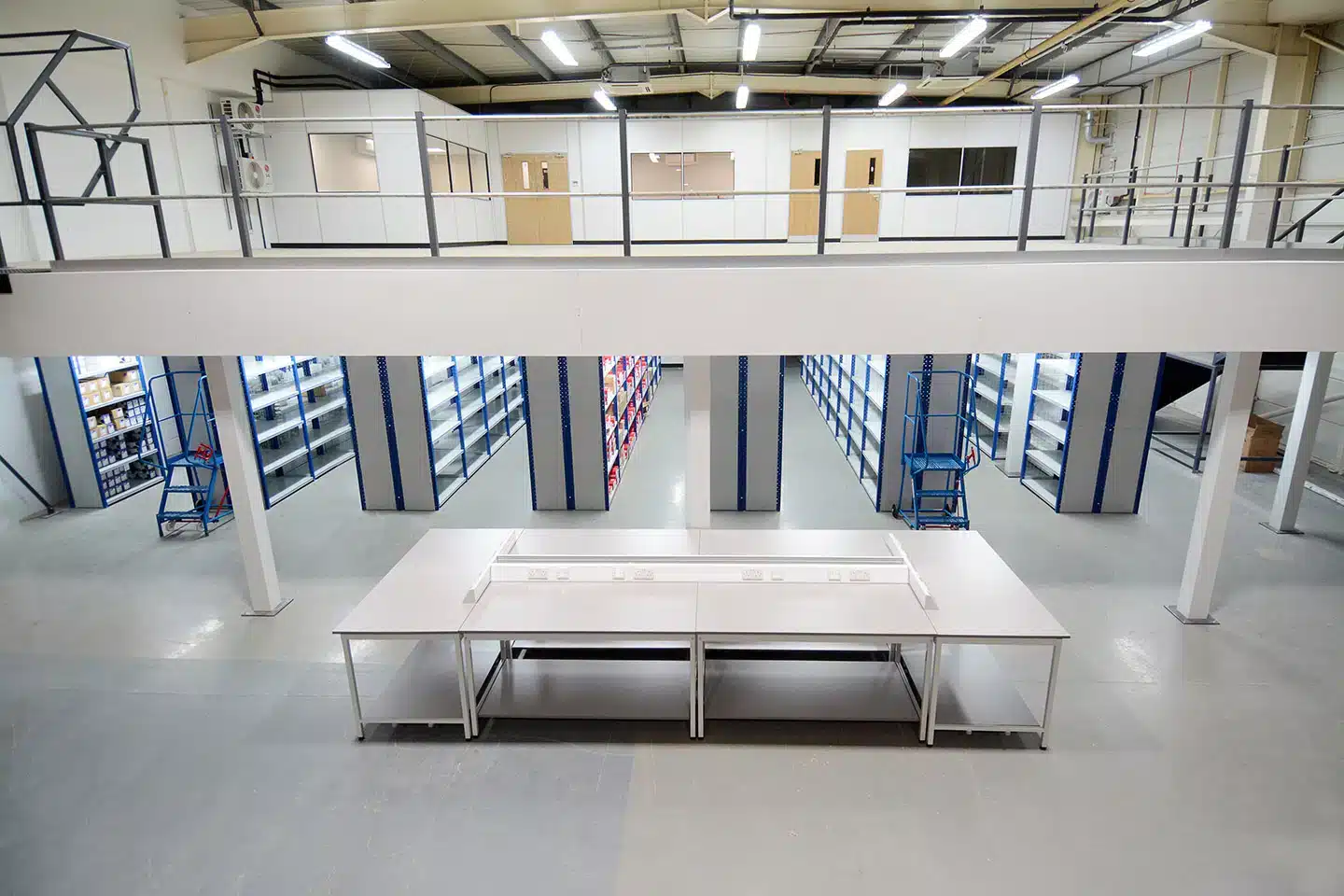
  • Office mezzanine – these office mezzanine floors are designed for additional office facilities and space and include partitioning walls, insulation and even soundproofing to block out warehouse sounds.
  • Multi-tier mezzanine – if you’re looking to maximise the vertical space in your high-bay warehouse you can opt for a multi-tier structure which builds levels on top of a standard mezzanine.
Not meeting the loading capacity of warehouse mezzanine floors?

The loading capacity of your mezzanine is critical. A typical warehouse mezzanine is engineered to hold between 360kg and 1,000kg per square metre. But, if your requirements changed and you decided to add heavier stock or machinery on to the structure it will place additional stress on the structure. Over time, the additional load will weaken the structure and increase the chance of it collapsing.

When we design warehouse mezzanine floors, the structure will be bespoke to your specific weight requirements. We will conduct structural assessments to determine the load distribution and design the quantity, thickness, spacing and size of the steel sections to ensure the structure is safe.

Not meeting fire regulations

Another area to pay particular attention is fire safety and access requirements. Even though mezzanines are classed as “temporary structures,” they must comply with regulations relating to load capacity, fire escapes, lighting, and access. All mezzanine floors require fire escapes with clearly marked routes and access for emergency services with other options including suspended ceilings, column casings, fire protection with staircase enclosures and sprinklers.

Be aware that UK building regulations may also require a fire-rating of one hour on certain structures.
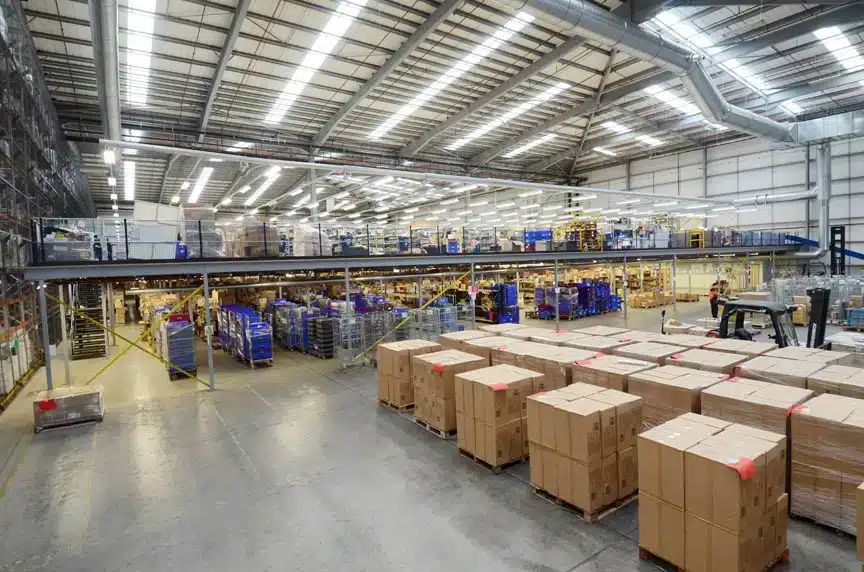
a full warehouse with warehouse mezzanine floors for online stock

Not designing the mezzanine for warehouse operations

How will the mezzanine fit seamlessly in your space – a key factor when retrofitting into an operational warehouse. If you don’t consider how the mezzanine will fit in your footprint and work around existing racking or machinery, it could change the flow of your warehouse resulting in bottlenecks.

The final design of your mezzanine should look at how your team access and exit the space, enhance your current processes and improve the operational flow of your space to increase space optimisation. Will you need on-floor design features such as doors, windows, and wall partitions to create separate rooms for offices, canteens, clean rooms, or segregated work zones? If you’re using the space to store stock or for manufacturing, have you considered how the items will get on and other the floor? Do you need to provide adequate space for other equipment or automation systems?

Don’t worry, when you work with Teepee, we’ll create mezzanine solutions that help you work through all the small details which make the difference between a successful mezzanine that boosts your operations.

Failing to future-proof your mezzanine structure

Warehouse needs often change which is why you should always future proof storage equipment such as racking and shelving to allow for growth and additional storage areas. The same concept should apply to your mezzanine floor. As a modular structure, there are options to extend, reconfigure or relocate the structure to provide new storage solutions when required.

One of the smartest moves a warehouse can make is to design mezzanines with future flexibility by increasing the weight loading capacity of the structure. Even if automation or heavier loads aren’t on the horizon today, they may well be in three or five years’ time. Building in extra load tolerance at the outset saves costly modifications down the line.

Of course, any new systems such as conveyors, AMRs and shuttle systems will create additional loads on the structure and you should only add new equipment once you have spoken to your supplier and a structural engineer.

Need a mezzanine – work with Teepee

Thinking of having a mezzanine installed? Here at Teepee, we have over 40 years of industry expertise in storage solutions. Work with us and we’ll provide you with a free site survey and design consultation with our design team to ensure your bespoke mezzanine is tailored exactly to your business. We can typically install your warehouse mezzanine floor, from design approval to completion, in as little as 3 to 6 weeks.

Mezzanine floor FAQ:

  1. How much do warehouse mezzanine floors cost?

    The cost of a mezzanine floor depends on several key factors. Larger floors and those built to support heavy industrial loads will naturally cost more due to the stronger materials and structural supports required. However, other factors will impact on the price including extras such as goods lifts, pallet gates, lighting, partitions and finished flooring. Other factors include fire rating (typically 30–60 minutes), access equipment like staircases or conveyors, and any bespoke design or fit-out needs. Costs can also vary depending on the complexity of the project.

    At Teepee, every mezzanine is tailored to your facility, get in touch for a no-obligation quote to find out how much a mezzanine might cost your business.

  2. What happens if a mezzanine floor is overloaded?

    Overloading can cause deflection, vibration, or even structural failure. This not only puts your staff at risk but also breaches safety and compliance laws. Installing a mezzanine that’s not correctly rated for its intended load is one of the most common mistakes warehouse operators make. You’ll typically need a minimum internal height of 4.5 to 5 metres to allow for safe head clearance above and below the mezzanine. This ensures the space remains functional and compliant with building regulations.

  3. How high does my warehouse need to be for a mezzanine floor?

    You’ll typically need a minimum internal height of 4.5 to 5 metres to allow for safe head clearance above and below the mezzanine. This ensures the space remains functional and compliant with building regulations.

  4. Can I add shelving or pallet racking on warehouse mezzanine floors?

    Yes, but the mezzanine must be engineered for the additional load. Storage mezzanine floors that support racking or shelving require higher load ratings and may need reinforcement columns or thicker decking materials.

  5. How do I ensure my mezzanine is compliant and safe?

    Work with a reputable installer like Teepee, who will handle the design, engineering calculations, Building Regulations submissions, and fire safety requirements. Every mezzanine should come with load signage, handrails, kickboards, and certified drawings.

13

Jan

How Can You Trust Your Pallet Racking Suppliers

There is no escaping the fact that getting new racking for your warehouse is an expensive outlay. Of course, there are always pallet racking suppliers out there offering ‘cheap’ solutions, but make the wrong decision at the purchasing stage and undoubtedly it will cost more in the long run.

We explain what to look for in pallet racking suppliers and whether a company with the highest level of credentials will end up costing you more.

What credentials should pallet racking suppliers hold?

Do a quick Google for pallet racking suppliers within the UK and you quickly realise there are a lot of companies out there. However, with few barriers to entry, how do you know which one to pick? One option is to check their credentials. Companies like Teepee that are committed to continuous improvement and working to the highest standards are likely to hold several accreditations. Here are some of the accreditations you may come across, although it is worth noting that holding them does not necessarily guarantee a high level of quality in pallet racking installations.

Pallet Racking Supplier

ISO – Pallet Racking Suppliers

The ISO is an internationally recognised standard seen as a formula for the best way of doing something, whether it’s making a product, managing a process, delivering a service or supplying materials. In the pallet racking industry, you will usually see ISO 45001 which covers occupational health and safety management systems, ISO 14001 which covers environmental management systems and ISO 9001 which covers quality management systems.

CHAS – Pallet Racking Suppliers

CHAS is the Contractors Health and Safety Assessment Scheme (CHAS) accreditation that proves a contractor’s health and safety processes meet a high level of compliance. The accreditation demonstrates that the company comply with the law, has sound management of current health and safety legislation and follows best practices.

SafeContractor Pallet Racking Suppliers

SafeContractor is a third-party accreditation scheme that creates a unified system which enables customers to check their contractor’s credentials and ensure compliance across the supply chain. A business must prove that it meets current legislation and has processes in place to ensure it handles health and safety in the best way possible to achieve the approved status.

While these accreditations prove safety during the construction of your pallet racking system, they do not directly relate to the equipment. As you explore your options, you might also come across companies that are accredited as SEMA Approved Members.

SEMA Approved Member - Advanced

What is a SEMA Approved Member?

Let’s start by explaining about the Storage Equipment Manufacturer’s Association, commonly known as SEMA. For over 50 years, they have been a leading voice on the safety and quality of storage equipment such as pallet racking and shelving. Led by the combined expertise of their technical committee, they provide the industry with comprehensive codes of practice and documents which guide both warehouse owners and suppliers of storage equipment.

Their work extends over the lifetime of a pallet racking system, starting at the beginning with the design and manufacture of the structure right through to upholding safety in use and implementing a regular racking inspection regime. Manufacturing, supply, and installation companies make up the association membership. They also run two initiatives which train on installation methods and inspection processes.

What are the advantages of using SEMA Approved Members?

For a warehouse owner working with a SEMA Approved Member can save a lot of time and effort. When purchasing pallet racking solutions, the HSE will expect you to meet certain criteria and check the credentials of your supplier as stipulated in their guidance HSG76 Warehousing and Storage: A Guide to Safety. Although it is not a legal requirement to follow the advice in this document, adhering to the guidance is usually enough to comply with legislation. Work with a SEMA Member and you can save a lot of leg work to check your supplier’s credentials.

Under SEMA, pallet racking suppliers of storage equipment like Teepee are known as SEMA Approved Members. You can only become a SEMA Approved Member if you can demonstrate that you work to SEMA Codes of Practice and meet their high levels of quality and enhanced warehouse safety standards. SEMA Approved Members offer a level of expertise and can design a pallet racks solution that will maximise your storage space, enhance efficiencies and increase productivity. They can also review your warehouse space to ensure your new racking will not only meet your current operations but is ready to expand to meet future requirements.

SEMA Approved Member

SEMA Approved Members Credentials

Pallet racking and shelving suppliers must undergo a rigorous independent audit once every five years. This audit will check the supplier meets SEMA requirements by adhering to over 40 regulations, industry standards, Codes of Practice, and legislative requirements. This provides you with peace of mind that your efficient storage will meet expected load capacity, deliver expected outcomes while also meeting the highest safety and quality levels. SEMA Approved Members must also commit to using SEIRS installers, and SARI inspectors. SEMA membership also checks the company has the correct insurance documentation in place, follows health and safety measures in place and environmental best practice.

There are two levels – SEMA Approved Member and SEMA Approved Member – Advanced. Teepee are SEMA Approved Members – Advanced. This means we demonstrate our commitment to a high SEMA criteria level as demonstrated through the audit.

Is a SEMA member more expensive?

Now you know that Approved Members such as Teepee are working to enhanced warehouse safety levels and the highest quality standards within the industry, it begs the question – is a SEMA Member more expensive? Of course, every supplier is different, and it is not necessarily the case that a SEMA member will be more expensive. However, when comparing quotes, you should consider how your supplier will impact ongoing costs.

With a SEMA Approved Member, you get peace of mind that covers the lifetime of your equipment. Through the guidance provided by SEMA, we offer support to warehouse owners throughout every stage of their pallet racks.

We also have the expertise and knowledge to supply bespoke pallet racking and shelving systems designed to enhance cost benefits. This includes maximising available storage capacity, boosting productivity and considering longevity by incorporating opportunities to extend or alter your pallet racking to accommodate future or changing business growth. The design should also minimise ongoing remedial costs by reducing unnecessary wear and tear.

Return on Investment

Once your adjustable pallet racking system has been installed, to maximise the Return on Investment, we support your team by offering training for your employees which guides how to work correctly in areas with pallet racking and minimise damage. Our interactive Racking Awareness, Safety & Inspection Course will also prepare a member of your team to undertake the weekly safety inspections – a requirement under PUWER.

There is one last advantage to working with a SEMA Approved Member and that is through the relationship we have with Manufacturer Members. When needing repairs on your adjustable pallet racking systems, you should be aware that not all work is valid – you can visit SEMA’s website for guidance on their recommendations.  We have access to SEMA Manufacturing Members’ documents and keep them up to date on approved repairs to their equipment. The manufacturer covers any work we undertake, which will therefore protect your equipment warranty.

Why work with Teepee?

Are you looking to improve your storage solutions? At Teepee, we have created a wide range of storage solutions for major manufacturers and retailers across the UK and, with over 40 years of experience within the industry, we can help you maximise your warehouse. As pallet racking suppliers we are product agnostic which enables us to design and supply the ideal pallet racking system to meet your needs.

We can deliver maximum operational efficiency by working with you to deliver a range of warehouse racking systems, including narrow aisle racking, wide-aisle racking, drive-in racking and push back racking. We can also design and supply mezzanine floor and partitioning systems that maximise your floor space. Plus, we work closely with our customers to design bespoke storage systems that get to the heart of their business to maximise their storage and boost productivity.

If you have any questions, get in touch with one of our team who are on hand to help you out.

04

Mar

Improved warehouse safety – make your racking a priority task

Safety has to be a priority in any warehouse. They are busy environments. Heavy stock is moving around and you must protect employees while working in the space. However, over recent years with the fast growth in e-commerce, pressures have increased within the warehouse. With a drive for additional storage capacity and faster throughput of stock, are you remembering to maintain warehouse safety?

In the warehouse, the main focus areas for safety are slips and falls, manual handling and keeping your employees safe around moving vehicles. The challenge, especially as our warehouse spaces get busier, is how to minimise the risks. This is where your racking comes into play. Get the design of your storage equipment right, take the correct measures on maintenance and training and it will address many of your safety issues.

Here is our checklist of key points to consider to maximise pallet racking safety.

warehouse safety - pallet racking safety

Warehouse Safety – roles and responsibilities

Before we look at how your pallet racking can make a warehouse safe, you first need to understand your responsibilities towards warehouse safety. Fortunately, serious incidents around racking are rare, but they can and do still happen. This is why there are several regulations and guidance documents in place that any business owner must follow to meet their health and safety requirements. These are:

In addition to these, there are three regulations and guidance documents which specifically relate to increasing warehouse safety. These also cover safety in the design, installation and use of your pallet racking equipment.

Construction Design and Management Regulations 2015 (CDM 2015) sets out the legal duties of everyone involved in a construction project. Although you may not realise it, large pallet-racking projects fall under the category of construction work. CDM 2015 requires the client (anyone who has construction work carried out for them) to make sure their project is suitably managed and upholds the health and safety of anyone involved.

In conjunction with industry unions, associations and employer bodies, HSE produces HSG76 Warehousing and Storage: A Guide to Health and Safety. The document offers advice to warehouse owners in increasing safety and covers general health, safety and welfare, materials handling and storage.

Provision and Use of Work Equipment Regulations, 1998 places the responsibility on employers to uphold safety for their employees by ensuring the work equipment they use is in good working order. The regulations include pallet racking and other storage equipment.

Increase Pallet Racking Safety

Making sure your racking equipment and warehouse space meet industry regulations is essential. However, in an industry with so many different suppliers, knowing who to work with can be a challenge. How do you know they have chosen the right system for your warehouse? Does the design increase warehouse safety standards? Will the structure meet its intended purpose? Are they meeting all the regulations?

Checking the credentials of your suppliers can take a lot of time, especially if you’re not a racking expert! One place to start is by contacting SEMA, a leading voice in the storage equipment industry. Their guidance works through the design, supply, installation, use and maintenance of storage equipment.

To help warehouse owners even further they also work with leading industry suppliers to create a network of approved members. Work with a SEMA Distributor Company such as Teepee and you know they undergo independent audits to ensure they meet all the industry requirements and standards. This provides clear proof to warehouse owners that their new storage system will be correctly designed using new products that are installed by trained and qualified teams to meet HSE standards and that the member is correctly insured. It will save you a lot of time and effort making sure you tick all the health and safety boxes!

warehouse safety - loading

Prioritising pallet racking safety

One of the advantages of working with a SEMA Distributor Company is that you know they are benefitting from the technical expertise available through the group. That means we are kept up to date on the latest industry regulations, technical requirements and design guidance.

To enhance your warehouse safety, we will make sure that your racking considers the following:

  1. Safe working spaces
    Keeping your employees safe when working in areas with pallet racking has a lot to do with the layout of the equipment. Of course, optimising the racking must address how to increase storage capacity, processing order timescales and productivity. But good design and layout will also help reduce accidents, keep your employees safe from moving vehicles and minimise the risk of slips or trips. This includes creating clear pathways, designated loading and unloading zones, and ensuring stock is accessed safely.
  2. Moving vehicles
    In the modern warehouse, you will inevitably see some form of vehicle moving around the space. Forklift trucks are the most common but, with the increase in automation and robotics, the requirements are changing. However, with warehouse workers also using the space there needs to be constant management to prevent accidents. Traffic routes around the racking should allow pedestrians to see the vehicles and drivers to operate safely. Where possible, employees should be kept separate from the vehicles.
  3. Racking designed for stock profiles and picking methods
    As warehouse spaces become larger, so too do the size and height of the racking structures. It is not unusual for workers to work above floor level on mezzanine or multi-tier structures or through the use of forklift trucks. Keeping everyone safe on the shop floor requires a design that includes enough space between the beams for the picking methods, equipment used and stock profiles. The racking aisles must also accommodate safe access to goods, use correct racking protection products and incorporate the moving space of fork-lift trucks and robotics.
  4. Pallet racking – weight limits
    The design of your racking includes limits on the weight the structure can hold and how to load it correctly. The precise details can be different for each bay or racking run depending on the stock you carry. Important guidance when you consider that, in its simplest form, your racking is a basic metal frame. Ignore the weight-carrying specifications and it can lead to a potential failure of the racking. You can’t expect everyone to remember the different weight-carrying capacities which is why your employees need to pay attention to the Load Notice. This key warehouse safety sign clearly shows the correct loading and weight procedures for the structure.
  5. Pallet racking safety equipment
    If you have the optimal design for your racking it should keep everyone safe. However, it can only meet its intended purpose if everything is working correctly. Your supplier should also build in safety equipment that protects the racking from damage including rack guards and post protectors. Finally, for correct installation of the structure you must use a SEIRS installer who has trained to meet SEMA and industry standards. That way you will know pallet racking safety pins are correctly securing beams in place. Locks are in place to ensure adjustments are not be made by unauthorised members.

warehouse safety - rack protectors

Improving Safety

The racking is in place and stock is moving through the space seamlessly. Stock efficiency has increased to minimise order timescales and increase your profitability.

Now the biggest challenge – how to keep it all working correctly!

The answer lies in equipping your employees with the knowledge of how to work in areas with racking. It may seem easy to dismiss racking training as an unnecessary step, but it does provide you with two clear advantages. First, and perhaps most importantly, it will keep your employees safe. Second of all, it will help to maximise the lifespan of your racking (which is ideal for maximising the ROI).

That is why we run our Rack Inspection Training. The course equips your employees with the skills and knowledge they need to work safely in areas where racking is present. It also provides them with the tools they need to recognise damage on racking. After all, the sooner damaged racking is reported, the sooner it can be fixed and the safer everyone stays. Finally, our course will help you in meeting your PUWER responsibilities by training a member of your team to perform the HSE and SEMA recommended weekly inspection.

warehouse safety - inspection

Ongoing Warehouse Safety

The final step is to ensure your racking keeps everyone safe for as long as possible. You can only achieve this if the structure is subject to an Expert inspection at least once a year. This inspection must be undertaken by a professional with the correct qualifications. Their role is to conduct racking and storage assessment reports on the racking and recommend if repair work is required.

Ideally, you want an approved racking inspector who uses a traffic light reporting system according to SEMA guidelines. Their report will indicate where damage is present and action requirements over what timescale.

  • Green areas indicate where damage falls within SEMA limits and is considered safe and suitable for use, but it will need reviewing at the next inspection.
  • Amber shows where the damage is severe enough to require remedial work, but you don’t need to offload the racking immediately. As pallet positions empty, you must not refill the area. Repairs not completed within four weeks automatically become a red risk.
  • Red risk areas indicates a dangerious level of damage and the racking requires immediate offloading. At this stage, you must isolate the racking and not use it until the repair work is complete.

If you need an expert inspection, get in touch with Teepee and we can arrange for one of our fully qualified and insured racking inspectors to visit your site. They will produce an electronic report that adheres to SEMA inspection guidelines. The report will detail specifications, conditions, damage list by location and photographic evidence for remedial works by your approved supplier.

Need help in upholding warehouse safety?

At Teepee, we’re more than just creating and delivering the perfect storage solution. We place safety and high standards at the forefront of every racking design and installation we fulfil.

If you’ve got a warehouse storage project planned, why not contact Teepee? Our experience within the racking and warehouse industry means that we can help deliver a project that promises safety, quality and reliability throughout the lifetime of your racking.

08

Jan

How to Find a Pallet Racking Supplier: A Guide

Have you recently taken on a new warehouse? Maybe you’re looking to give your racking a boost because your current equipment isn’t working for your business. Whatever your plans, there will definitely be a wish list of requirements for your racking to deliver. But, getting there isn’t as easy as you think. When making such a big investment, it’s crucial to choose a pallet racking supplier who can deliver a precise mix. This includes choosing the correct equipment for the job and a design that maximises safety and works for your business.

However, search for a pallet racking supplier and you quickly find it is a saturated market. Choosing one can be incredibly difficult. How do you know if they are qualified for the job? Will their design and racking choice deliver the most for your business? How do you know if they’ll maximise Return On Investment (ROI)?

In these days of ‘buyer beware’ it’s right to be cautious with your buying decisions. After all, racking may look simple, but the complexity of your system’s design, manufacture, and installation cannot be ignored. Especially when you consider the critical job it does to safely hold tonnes of product above your employees’ heads. In our blog, we look at the key areas to consider when choosing a pallet racking supplier.

choose the best pallet racking for your businessHow can pallet racking help your business?
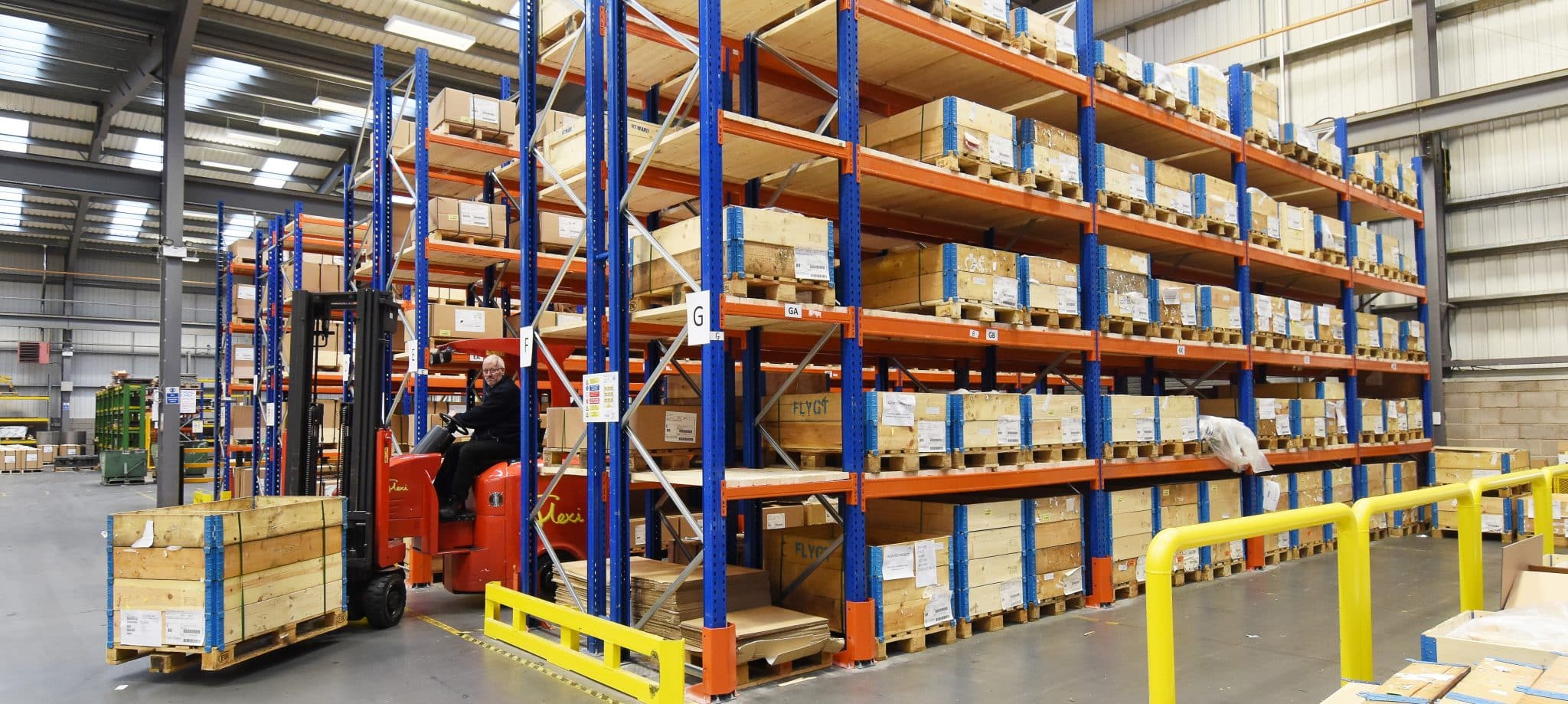
Let’s start with the basics, why does getting the correct pallet racking for your business matter so much? As the growth in online shopping continues, the need for a workable warehouse is more important than ever.

Your racking plays a central role in delivering on expectations and should deliver on the following four areas:

  1. Maximise productivity: As a business owner, you want to your warehouse to run efficiently to maximise productivity and increase revenue. With the correct layout, your racking should maximise storage capacity, improve inventory management and make the journey from initial order to leaving the warehouse as seamlessly as possible.
  2. Meet industry regulations: Within the warehouse and racking industry there are numerous regulations that every business owner must be aware of. Your racking installation, depending on the size of the project, might fall under Construction Design & Management Regulations 2015 (CDM 2015) requirements. Guidance has also been provided by the HSE in HSG76 Warehousing and Storage: A Guide to Health and Safety. Although it is not a legal requirement to follow their advice, doing so can help you meet expected Health & Safety standards. Lastly, your racking is classed as work equipment and falls under the requirements of PUWER.
  3. Create a future-proof warehouse: Your racking is a big outlay, and you want to protect these costs as much as possible. To future-proof your warehouse and your investment, you need to consider whether the design of your racking has accommodated potential growth or adaptability in changing stock profiles.
  4. Increase safety: Last, but not least, there is the element of safety. Your racking should put safety at the forefront and aim to protect your employees at all costs. Does the design of your racking incorporate features such as safe zones, reducing the risk of falling loads or designated processing areas? These can all help to protect your employees while they work around the racking.

What to expect from a pallet racking supplier?

how to find a pallet racking supplier

So, with an abundance of suppliers on the market, what should you expect when you get in touch with a racking company?

After the initial consultation to establish your requirements and understand if your distributor can meet your requirements, the pallet racking supplier should visit your warehouse. This enables them to fully examine your warehouse processes and space before on the best system for your business.

They should be looking at the available space in your warehouse which includes the floor capacity and height of the ceiling. They will look at how often you need to access pallets and if you need zones for different processing tasks. The review should also consider the shelf life of the items you are going to palletise and their storage requirements. Answering questions like these will lead towards choosing the most suitable racking and design for your business.

Apart from the basic requirements of product system knowledge and correct design, you also need to work with a pallet racking supplier who can give your warehouse a boost. Warehouses have become multi-functional spaces and must work harder than ever. To meet these demands, you will probably need multiple systems for your project. Work with a supplier, like Teepee, who can deliver a turnkey solution which uses a range of products from different manufacturers. This affords us the flexibility to pick and choose the very best solution that meets the characteristics and needs of your business.

Using Teepee as a central contact point will save you a lot of time and energy. Gone is the need to negotiate with different companies and arrange delivery timescales and installation schedules! Working with our experienced project management team will minimise disruption to your business and ensure the installation complies with statutory requirements, building control, and CDM 2015 regulations.

Do their racking installers work safely?

does your pallet racking installers work safely

Once you and your supplier have worked through the most appropriate design for your warehouse, it’s on to the installation stage. Ensuring ongoing safety through the quality of the racking installation is an area that is often overlooked. Yet, making even one small mistake at this stage can increase unnecessary damage to the structure or, at worst, render the racking dangerous.

Always check that your supplier is working with installers who have gained industry qualifications. Never assume they are correctly trained. In reality, most installers learn on the job, and it is very easy for them to pick up bad habits. One recognised, industry qualification is SEIRS. Run by SEMA, SEIRS instructs on correct racking installation methods, industry-specific requirements for the job and practical skills when installing racking.

SEIRS is also a recognised qualification by the Construction Skills Certification Scheme (CSCS). So, if your racking project does fall under the remit of a construction project, you can be sure that your SEIRS CSCS installer has the qualifications to meet H&S requirements to work on site.

What after-sales care does your pallet racking supplier offer?

Once your racking is in place, the support from your pallet racking supplier shouldn’t stop! Do they have an after-sales team who can answer any queries? Will they come to the site if any problems do occur? Can they also advise on the best way to protect your racking from damage?

To protect your investment and enhance safety in the warehouse, your pallet racking supplier should provide training for your employees. This provides them with the knowledge required to work safely around the racking and identify when damage occurs. The training should also guide you on how to perform weekly inspections that confirm with HSG76.

As the owner, you must also get an approved racking inspector to inspect your equipment at least once a year. Their detailed inspection report will cover the suitability and compatibility of your equipment, and rack configuration type and classify any damage using a traffic light system to indicate actions required and the recommended timescale to address them.

How to find a pallet racking supplier?

how to find a pallet racking supplier

Now you know why you need correctly designed racking and what to expect from your supplier, it’s time to find the best company to work with. Of course, we’ve all done it, jumped on Google to search for a business before clicking on a few to check their company website. They all look impressive, demonstrate their experience and have plenty of testimonials and case studies. But is this enough? Does this make them reliable enough to put such a big investment into their hands?

Some words of warning. Experience is not always a measure of quality and safety. There are also very few barriers to entering the pallet racking market which means not every company has gained an accreditation to start supplying.

One of the best places to start is by heading over to the SEMA website. The Storage Equipment Manufacturer’s Association (SEMA) are a leading voice on safety and quality within the racking industry. They offer guidance on everything from meeting industry regulations to safety in racking installations all the way through to implementing the correct inspection procedure.

Companies, like Teepee, can apply to become one of their members as a SEMA Distributor Company. To successfully gain our badge, we have to demonstrate via an independent audit, that we adhere to over 40 key measures. These include regulations, industry standards, SEMA Codes of Practice and legislative requirements. On top of that, every three years we must submit to another independent audit to ensure we retain the expected quality and safety standards.

Racking Solutions From Teepee

Now you know what to look for from your racking supplier, are you ready to get started? If you’ve got a warehouse storage project planned in the near future, why not get in contact with Teepee? We will provide you with a free, no-obligation quote for the job. Plus with our long-standing relationship with suppliers, we have the skills and knowledge to deliver a full turnkey project.

Why not get in touch today?

12

Dec

Warehouse Pallet Racking Installation: A Complete Guide

Getting a new warehouse pallet racking installation in place can be a logistical headache for a lot of business owners. Whether extending current racking or moving to a new facility, there are a lot of different considerations to account for.

If starting from scratch, you need to ask yourself crucial questions. Have you got the best design and choice of racking to improve operations? Are you dovetailing in new racking into an existing structure? Furthermore, how will it compromise your business while the work is going on? On top of all that, are you meeting your Health & Safety responsibilities?

In this blog, we guide you through the key questions to ask when you begin your warehouse racking installations. We also look at the best pallet racking systems for your warehouse, how to choose a racking supplier and how to prepare for the final build.

Warehouse racking setup by Teepee Materials Handling: experts in pallet racking installation

Book Your Racking Installation Today

Warehouse Pallet Racking Setup: How To Choose The Right Design

When planning new warehouse racking, before you even get to the installation, there is a checklist of three key areas you must cover:

  1. Design and racking type
    Have you got the best racking for the job? Does the design work for the throughput of your stock as it travels through the warehouse? This requires extensive planning by a supplier who has experience in getting the most out of your space. Get this stage correct and it will increase storage capacity, reduce pick and packing times and improve productivity. Most importantly, it will keep everyone safe.
  2. Are you meeting industry regulations?
    Most warehouse racking installations fall under the category of a construction project and are covered by HSE’s Construction Design & Management Regulations 2015. As the client, you are responsible for checking you have the ‘right people for the right job’. Check the suppliers credentials to ensure they meet health and safety requirements. Are they using trained labour for the design and installation of your racking?
  3. The right supplier
    To meet conditions 1 and 2 on our checklist you need a responsible racking supplier. But, with thousands of racking suppliers listed in the UK, knowing which one to choose is a minefield. When you work with Teepee, we can prove our safety and quality credentials through our position as a SEMA Distributor Company. To gain our membership we have to meet over 40 industry and SEMA standards and demonstrate our commitment to quality and safety through an independent audit. To demonstrate our commitment to meeting SEMA’s high standards, we have to undergo the accreditation process every three years.

Once you’ve ticked all the boxes, it’s time to get the warehouse racking installation in place.

Warehouse racking being setup and installed by Teepee Materials Handling Can I Install My Own Pallet Racking?
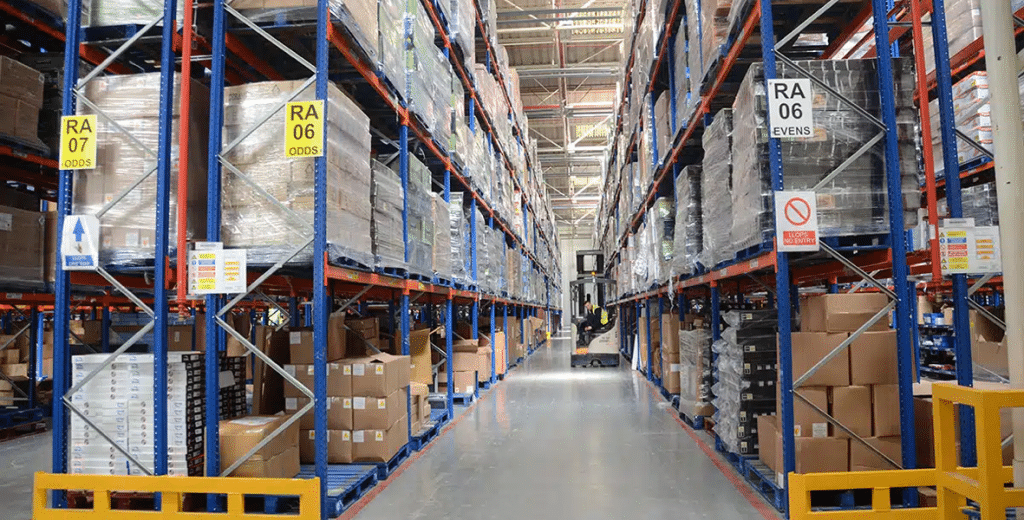
So, a commonly asked question is whether you can install your pallet racking. After all, it sounds appealing to save some costs if you’re only adding in a few additional bays. The truth is that yes, you can install your racking, but it is not something we would ever advise. To understand why, you would need to look at the apparent simplicity of the structure.

When stripped back, racking is a basic structure with very little to it. However, it is this factor that makes correct installation so important. Miss out an important part of the manufacturer’s specification or fail to address key elements in the design code and it will severely comprise the strength of the racking. Take that away and you’re looking at the nightmare of a potential racking collapse.

That’s why at Teepee we only work with installers who have gained industry qualifications in warehouse racking. Not convinced? There are a lot of advantages to making sure you only use trained installers.

Why Choose Qualified Pallet Racking Installers?

The first critical benefit is safety. The installation of racking is a skilled job that requires a high level of practical and technical knowledge.

During the installation, to ensure your racking is up to the job, it must meet certain criteria. For example, do the number and type of floor fixings meet manufacturer tolerances? Have they been correctly positioned and tightened?

The next benefit is reducing ongoing costs. Badly installed racking is more likely to become damaged through unnecessary wear and tear weakening the integrity of the structure. Invest in the installation of your racking and it will pay you back in the long term.

If safety and reducing costs weren’t enough of an incentive, there is also a risk of you failing to meet industry regulations. Take a look at HSG76 Warehousing and Storage: A Guide to Health and Safety which advises warehouse owners on the correct steps towards improving warehouse safety. In the area of warehouse racking installations HSG76 recommends that “racking should only be installed by competent people according to manufacturer’s instruction”. To make sure your installer is ‘competent’, you need to make sure they have received relevant training.

Contact Teepee Materials Handling Today

Warehouse racking being set-up and installed by the team at Teepee Materials Handling

How Do I Check My Installer Is Qualified?

You should never assume that your supplier has a trained installer. There are very few installation courses out there and many installers still learn ‘on the job’. Over time it is very easy for an installer to pick up bad habits, or worse, they never learn the correct methods in the first place.

The first thing to do, is check if your installer has a SEIRS card. Run by SEMA, SEIRS is a national scheme which rigorously trains installers on correct installation methods per industry standards. Installers who have been through SEIRS can demonstrate that they have built up a solid foundation of industry-specific knowledge and practical skills needed for installing racking structures.

SEIRS is also recognised by the Construction Skills Certification Scheme (CSCS). An installer who holds a SEIRS CSCS has the correct skills and experience for installing racking on construction sites and will cover your requirements under CDM 2015.

Pallet Racking installed by Teepee Materials Handling in a warehouse

How Do I Prepare For Warehouse Pallet Racking Installation?

Looking to install new warehouse racking? Work with Teepee and you know we will work to the highest quality and safety standards throughout the process.

To make sure we understand your needs properly we will first visit your site to analyse the layout, understand your needs and the issues you want to address. We will also look at technical aspects such as how to effectively utilise the available space, reduce product handling, and improve access and suitability of the space and floor for the racking. At this time, especially if we’re installing in a live environment, we will work with you to plan the best route to installation and minimise any disruption to operations.

Once you have approved the quote and design, the installation work will take place. Depending on the design and warehouse characteristics, the installation time will vary, However, we strive to get your business up and running as quickly as we can while working hard for the best results.

Warehouse Racking Setup: Contact Teepee Today

Teepee offers a range of services related to warehouse solutions, from the design, supply and installation right through to inspections and after-care. Call us at 01384 256969 or fill in our contact form and we will happily answer any queries you have or provide a free quote for your racking.

Contact Teepee Materials Handling Today


18

Oct

Types of Warehouse Pallet Racking: A Complete Guide

Do you know the difference from wide aisle to push-back pallet racking? Confused about whether you need multi-tier racking to drive-through racking? Our guide on the different types of warehouse pallet racking to help you find the perfect system for your business needs.

When it comes to creating a highly efficient space in your warehouse, it is your storage equipment that will deliver maximum impact. Yet, with so many different types of warehouse pallet racking systems on the market, choosing the best one for your operations can be overwhelming.

Established in 1987 and having a proven track record within the logistics industry, at Teepee we understand how getting the correct warehouse racking system in place will help you achieve optimum productivity. In this guide, we will explain the different types of systems that we provide, covering what each system is for, how it works, and the key advantages for your business. Firstly, it’s important to assess if pallet racking is the type of industrial storage solution your business needs.

Do I Need Racking or Shelving? 

This is one of the most common questions we’re asked at Teepee. There is no right or wrong answer to this one and it is possible to have both in your warehouse. In most situations, making a choice over racking or shelving largely depends on your space and the type of products you store.

Pallet racking – although not always the case, you normally choose pallet racking if you store items that are larger and heavier. The increased depths of the shelves make them ideal for holding pallets which you access by fork-lift trucks or automated processes. You can adjust beam to accommodate changing stock levels and utilise the full height of your warehouse.

Shelving – with shelving, you will usually store smaller and lighter items which are loaded by hand. Shelving is smaller than racking providing a more efficient space-saving solution. Goods are much easier to store and access, and due to its design, it tends to be a more cost-effective option.

What Type of Warehouse Pallet Racking Do I Need?

In its simplest form, warehouse pallet racking consists of metal frames and beams which are designed to safely hold up tonnes of stock. Yet, the way you configure the structure can have a huge impact on how well your warehouse performs. There are several different solutions and, with the correct design, your warehouse pallet racking will maximise your storage and streamline how stock moves through your warehouse. Here are your options.

Types of Warehouse Pallet Racking:

Wide Aisle Pallet Racking

Types of warehouse pallet racking: Wide aisle racking at Teepee Materials Handling

This type of warehouse pallet racking is suitable for:

  • Warehouses with space
  • Warehouses that need lots of flexibility and adjustments

How does it work?

As the name suggests this system consists of single or double runs which are separated by wide aisles (normally 2500 – 4000mm in width). It is a very versatile storage option that gives forklift trucks direct access to the pallets. The flexibility of this system allows you to store an array of palletised goods, perfect for handling a variety of product ranges.

Wide aisle racking has the flexibility to support a mix of stock profiles at the same time, yet with the flexibility to easily adapt when needed. It also provides you with better control and management of your inventory.

You can fit wide aisle racking with an array of accessories such as pallet support bars, skids, weld mesh and timber shelves, enabling you to store a vast range of none palletised goods.

Advantages:

  • A very common and simple system to install and use
  • Quick access to stock
  • Immediate and unrestricted access to each pallet
  • High throughput speed
  • Adapted and utilised to suit your requirements and space e.g., adapt the height of the rack, the number of rows and much more
  • Standard forklift trucks

Learn more About Wide Aisle Racking


Very Narrow Aisle Pallet Racking (VNA)

Types of warehouse pallet racking: VNA racking at Teepee Materials Handling

This type of racking is suitable for:

  • Limited floor space
  • High and increasing stock

How does it work?

If warehouse space is a problem, this is the ideal solution for you. As with the wide aisle racking, the system consists of single or double runs, but the true benefit is in the aisle space. The clue is in the name because this racking has aisles that range from only 1.5m up to 2.0m in width.

With VNA racking the sky really is the limit (almost) and you can take advantage of the full height of your warehouse. This makes it an ideal option if your business is growing. The racking can be put in place and additional storage space released as and when you need without having to relocate to a bigger warehouse.

Safety is key with this type of racking. The aisle width is too narrow for a standard truck to operate and instead requires a specialist VNA forklift truck. A wired guidance system fits to the floor which guides the trucks down the centre of the aisle. Stability is key. To avoid the chance of the racks being knocked by trucks, the racking must sit on an even, preferably concrete, floor.

Advantages:

    • Efficient use of warehouse space
    • Minimises need to relocate
    • Immediate and unrestricted access to pallets
    • High speed

See an example > A. Perry & Co (Hinges) Ltd | Teepee Warehouse Solutions

Learn more About Narrow Aisle Racking


Double Deep Pallet Racking

Types of warehouse pallet racking: Double deep racking at Teepee Materials Handling

This system is suitable for warehouses with:

  • Long shelf life / non-perishable stock
  • More than one pallet per storage unit

How does it work?

This is essentially a standard pallet racking system. However, the main difference is that this system allows you to create a depth of two pallets that sit back-to-back.

Double deep racking solutions require a specialised truck having telescopic forks, which enables the operator to place the back pallet onto the system first, and then place another pallet in front.

Advantages

    • Efficient stock control system
    • Maximises use of space
    • High density

Learn More


Multi-tier Pallet Racking

Types of warehouse pallet racking: Multi-tier racking at Teepee Materials Handling

This type of system is suitable for warehouses with:

  • Limited floor space
  • Manual picking systems
  • Quantities of small products such as online retailers

How does it work?

Multi-tier racking essentially creates a series of usable walkways at different heights throughout the racking. This has the advantage of maximising your floor space by creating multiple hand-loaded picking zones throughout the racking. Walkways are fitted between the shelves with access via a staircase.

Advantages:

    • Optimises height
    • High speed
    • Accessible and adaptable
    • Removes the need to install mezzanine floors
    • Improves picking and packing process

Learn More Here


Push Back / Pallet Live Racking

Types of warehouse pallet racking: Push-back racking at Teepee Materials Handling

Best suited for:

  • High-density storage in a limited area
  • FIFO or FILO operations

How does it work?

There are two systems available:

  • Push back racking uses a First In Last Out (FILO) system. Pallets load onto a specially designed gravity roll track that pushes previously loaded pallets deep to the back. This system can store up to 10 pallets deep allowing efficient use of warehouse space. When you pick a pallet, the next one behind will move forward. Pallets load and unload from the same aisle picking space. You can store several SKUs without the need for moving large quantities of pallets to gain access.
  • Pallet live racking work on a First In First Out (FIFO) method. It is ideal for fast-paced environments such as food manufacturing. Pallets roll down specially designed lanes that are controlled by a series of inbuilt brake rollers. Each lane is loaded with pallets at the replenishment side and collected at the picking face on the opposite side to control stock rotation and levels.

Advantages:

  • 85% space utilisation
  • 4m – 4m aisle widths
  • Quick and easy access to pallets located at the picking face
  • High speed
  • Boost productivity
  • No need for specialist equipment

Drive-in, Drive-through Racking

Types of warehouse pallet racking: Drive in / through racking at Teepee Materials Handling

Best suited for:

  • High-density storage
  • Bulk storage systems
  • Limited stock rotation
  • Cold storage environments (e.g., refrigerated and frozen warehouses).
  • Seasonal products
  • Low turnover products

How does it work?

Drive in racking is a high-density storage system which is ideal for warehouses that stock a large number of pallets per SKU. The design of your drive-in racking will maximise your storage space by minimising the number of aisles needed for trucks. Multiple racks sit alongside each other with pallets loaded onto designated lanes and accessed by forklift trucks. Each pallet is supported by pallet rails which are attached to the uprights of the system. Pallets to be placed back-to-back within a compact structure to optimise both the vertical and horizontal space.

There are two ways the forklift truck can access the pallets:

Drive-in this is designed on a last-in, first-out (LIFO) inventory management basis. The forklift truck loads and picks each pallet using the same aisle.

Drive-through this is designed on a first-in, first-out (FIFO) inventory management basis. The forklift truck has access to both ends and therefore can load from one side and unload from the other.

Advantages:

    • 85% space optimisation
    • Low risk of damage
    • Maximum flexibility – expandable

See an example > Minor Weir & Willis (MWW) | Teepee Warehouse Solutions

View Our Different Types of Racking Here


Types of Warehouse Pallet Racking: Contact Teepee Today

We hope that this page has helped you to find the right system for you. If you’re looking to increase your storage space, why not get in touch and see how we at Teepee can help. We work closely with our customers to design bespoke storage systems that get to the heart of their business to maximise their storage and boost productivity.

If you have any questions, get in touch with one of our team who are on hand to help you out.

Contact us today.

Get Your Pallet Racking Installed Today

11

Sep

Warehouse Racking Layout


When it comes to designing your warehouse, you can never plan enough. Do you know what layout you will have? What will your inventory management be like? What stock are you storing? How will it be handled? 

There are many different aspects and principles to consider. Yet get the planning right, choose the correct racking and it can provide numerous benefits for your business. It is all about making the most out of your warehouse to increase efficiencies, improve productivity and meet customer needs. 

We take you step-by-step through the different design aspects you must consider when talking to a racking supplier. If it does get too overwhelming, don’t forget that at Teepee we have a team of experienced warehouse pallet racking experts of 35 years who can work with you to design your perfect solution. We can take all the planning and designing weight off your shoulders, putting put your warehouse in the best hands. 

Are you ready to start? 


The Layout 

Warehouse racking layout

The first place to start is with the layout of your storage solution.  

Storage Volume 

Every warehouse has a maximum storage capacity. One of the most common issues is running out of space.

which means you either start planning to move to a bigger warehouse or rent additional space. Yet understanding how to maximise your constraints can make the most of the space with the flexibility to adapt in the future.  

Throughput 

How many pallets will there be passing through the warehouse? Once you have an idea of quantity it can help determine the right choice and layout of your storage system. For example, if you have a large number of pallets per SKU then a bulk storage solution such as a drive-in/drive-through racking will be worth considering but if you have multiple SKUs, you may need more than one type of storage system. 

Accessibility    

Of course, ease of accessibility to your stock will ensure orders get out of the door as quickly as possible. Consider who and what equipment is involved in the picking and packing process. This will not only drive productivity but will also improve safety standards. After all, if an obstruction stops a team member from accessing stock or no consideration is given to safe working zones you could run the risk of a serious accident occurring. 


Inventory Management

warehouse racking layout support

Getting your inventory management process in order is the optimum way to choose the best warehouse pallet racking system. At the same time it will also support your throughput of stock and drive ROI. 

How will you manage the inbound and outbound stock moving through the warehouse? Once the pallets arrive, what would the flow be like, where would they go and what is their journey? The team should make sure that the shipment is correct and moved to a designated racking system where it can be stored until used in the outbound process. 

This will then lead to the matter of traceability and always knowing what is inside the pallet and how it travels from point A to point B. By putting traceability as one of the priorities, you can achieve quality control and enhanced productivity. 


Storage Solution

warehouse racking layout support

Finally, on to the backbone of your warehouse – finding a racking system and design shape that works best for your business. 

Racking Systems  

With over 30 years of experience in the logistics industry, at Teepee we understand how getting the correct warehouse racking system in place will help you achieve optimum productivity. There are multiple pallet racking options and the type you need depends on your warehouse, stock and processes. If you would like more information, head over to our blog ‘Your guide on warehouse pallet racking systems’ which covers what each system is for, how it works, and key advantages. 

Once you’ve chosen the best pallet racking, it’s on to the design shape of the system. 


Design Shape 

  • U Shape is a simple design that allows inventory to move into and out of storage at different rates. As the name suggests, the warehouse pallet racking is set up in a ‘U’ shape with shipping and loading at the front the storage is at the back. From a land use perspective, it is known as the most economical design. It can also split the warehouse into three different zones – fast-moving storage and pick faces at the front, medium-moving storage in the middle, and slow-moving storage at the back.  This reduces the distances travelled to access the stock. 
  • I Shape allows inventory to move into and out of the storage at a uniform, fast rate. There is just one direction meaning the receiving area is at one end and the dispatch area at the other. If you do pick this shape, remember that the inventory will need to travel the whole length of the warehouse before being able to retrieve the stock. 
  • L Shape allows inventory to move into and out of the storage at a cross-docking operation. Loading and reception areas are on one side of the warehouse and picking and shipping are on the other. The rest of the space is then filled with storage. 


Warehouse Pallet Racking Safety

Safety and a warehouse should always go hand-in-hand. After all, the consequences of something going wrong with your racking while holding tonnes of stock is not worth considering. 

Yet, in an industry that is largely unregulated, knowing how to trust the experience of your racking supplier can be difficult to navigate. Does your supplier have the appropriate credentials to assure that your racking system is safe? Do they meet and exceed regulations required by industry standards?  

One way to get reassurance on the quality and safety of your supplier is to work with a SEMA Distributor Company (SDC). For over 50 years SEMA has led the way on providing best practice standards within the storage equipment industry. As one of their SDCs, every three years Teepee has to demonstrate their high level of commitment to industry standards by submitting ourselves to an independent assessment. During the rigorous process, we must show that we adhere to over 40 regulations, industry standards, Codes of Practice and legislative requirements to retain our membership and prove our credentials. 

We also follow industry best practice advice and use SEIRS registered installers. SEIRS is an initiative run by SEMA which trains warehouse pallet racking installers on the methods and processes to safely and correctly install pallet racking. 


Get in Touch

Looking to maximise your warehouse? Get in touch and see how one of our team can help you with the design of your racking. At Teepee we have 35 years of experience, providing services from the very beginning right through to the completion of the project. We can assure you that you will be supported through every key stage.